Take a Number and Lose a Day: The DMV Marathon That Defined American Bureaucracy
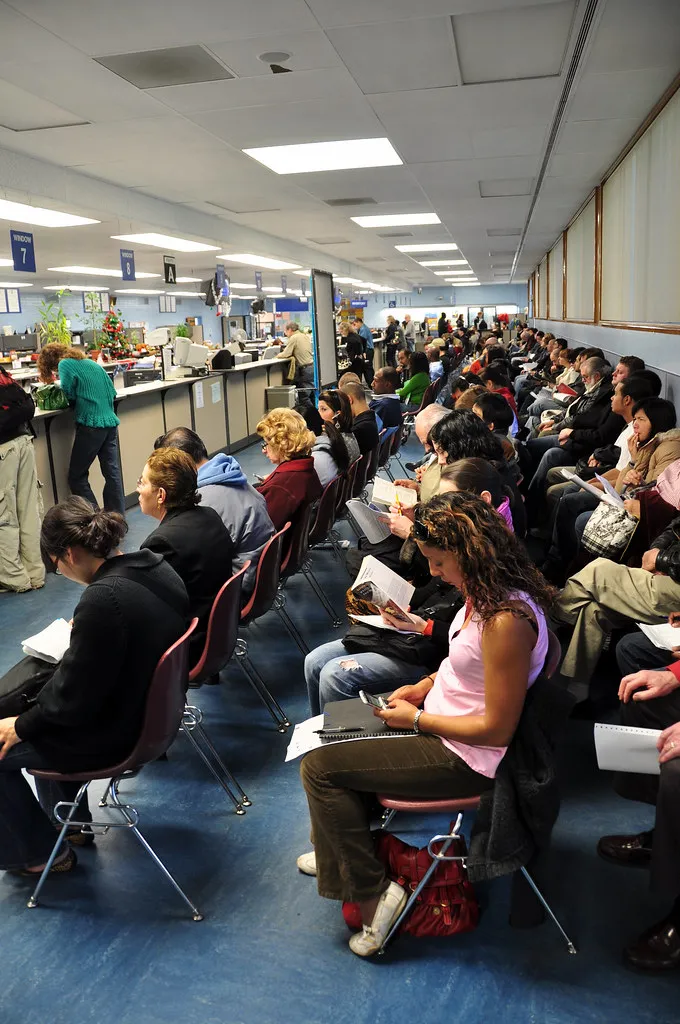
Photo: crowded DMV waiting room vintage 1990s fluorescent lighting numbered tickets, via gmufourthestate.com
Somewhere around 10:47 on a Tuesday morning in 1994, you'd finally accept it. You weren't going back to work. The meeting you'd planned to catch after lunch? Gone. The errands you thought you'd squeeze in? Forget it. You were at the DMV, you had ticket number G-114, and the display board was still blinking G-89.
For anyone who came of age before the internet reshaped civic life, the Department of Motor Vehicles wasn't just a government office. It was a rite of passage — a test of endurance wrapped inside a license renewal. And for millions of Americans across several decades, it was simply how things worked.
The Ritual Nobody Chose
The experience started before you even walked through the door. Figuring out which documents to bring was its own research project. There was no website to check, no confirmation email, no friendly chatbot to walk you through the requirements. You called a phone number — usually busy — or you asked someone who'd been recently. The advice you got was inconsistent at best.
Then came the drive. DMV offices weren't always conveniently located, and parking was often a problem in itself. Once inside, the process was immediate and impersonal: take a number, find a seat, and wait. The chairs were hard plastic. The lighting was the particular shade of fluorescent that makes everyone look slightly unwell. A television mounted near the ceiling might be tuned to a daytime talk show, volume low, subtitles off.
The numbered ticket system created a strange suspended reality. You couldn't leave — not really. Step outside for coffee and you might miss your number. The display board updated in irregular bursts, sometimes jumping three numbers at once, sometimes sitting frozen for twenty minutes. There was no app tracking your position in line. No text alert. No estimated wait time. You just sat there, watching, calculating odds, and slowly surrendering your afternoon.
When You Finally Got to the Window
Reaching the counter didn't mean the ordeal was over. It often meant discovering a problem you hadn't anticipated. Maybe your proof of address was the wrong type. Maybe your name on one document didn't perfectly match another. Maybe the clerk — overworked, underpaid, and facing their fortieth frustrated customer of the day — explained that your form was outdated and you needed the new version from the rack near the entrance.
Back to the rack. Back to a seat. Sometimes back to the end of the line.
The stakes felt disproportionate to the task. A driver's license renewal is, functionally, a minor administrative update. But in the pre-digital era, failing to navigate it correctly meant driving on an expired license — a legal risk — or returning to do the whole thing again. Some people took half-days off work. Others arranged childcare. The DMV consumed real resources: time, money, mental energy.
And yet everyone accepted it, because there was no alternative.
The Slow Arrival of Sanity
Change came gradually, not all at once. Some states introduced mail-in renewals for straightforward cases in the 1980s and 1990s. Others experimented with extended hours or satellite locations to reduce crowding. These were improvements, but they didn't transform the experience — they just made the worst days slightly less catastrophic.
The real shift came with the internet, and even then it moved slowly. Early government websites were clunky, hard to navigate, and didn't always work properly. Trust was an issue too. Entering your personal information and credit card number into a government portal felt strange at first — almost suspicious — to people who'd grown up handling everything in person.
But the infrastructure improved. States began investing in digital systems that could verify identity, process payments, and issue updated documents entirely online. Appointment booking arrived and changed the in-person experience dramatically. Instead of showing up and hoping, you reserved a slot, arrived at a specific time, and were seen within minutes.
Eight Minutes, Start to Finish
Today, renewing a standard driver's license in most US states takes roughly the same amount of time as making a cup of coffee. You log in, confirm your details, pay a fee, and receive confirmation. A new card arrives in the mail within a week. If you need to visit in person — for a Real ID upgrade or a first-time license — you book an appointment online, check in via a kiosk, and typically wait less than fifteen minutes.
The contrast is almost surreal when you hold it against the old reality. An entire category of civic frustration — the kind that spawned a thousand jokes, a universal sense of dread, and genuine scheduling anxiety — has effectively been engineered out of existence.
What's quietly remarkable is how completely people have forgotten what it used to be like. The DMV is still a punchline in American culture, a shorthand for slow-moving bureaucracy. But for anyone under thirty, that reputation is mostly inherited. They've never actually lost a Tuesday to it.
The era chasm here is wider than it looks. It's not just about convenience — it's about what everyday life cost in time and frustration before digital systems absorbed the friction. The DMV wasn't uniquely bad. It was just government operating at the speed that was technologically possible. And for a long time, that speed was very, very slow.