Eight O'Clock or Nothing: The Era When Television Decided Your Night
There's a moment that doesn't exist anymore, and it's worth pausing to think about it.
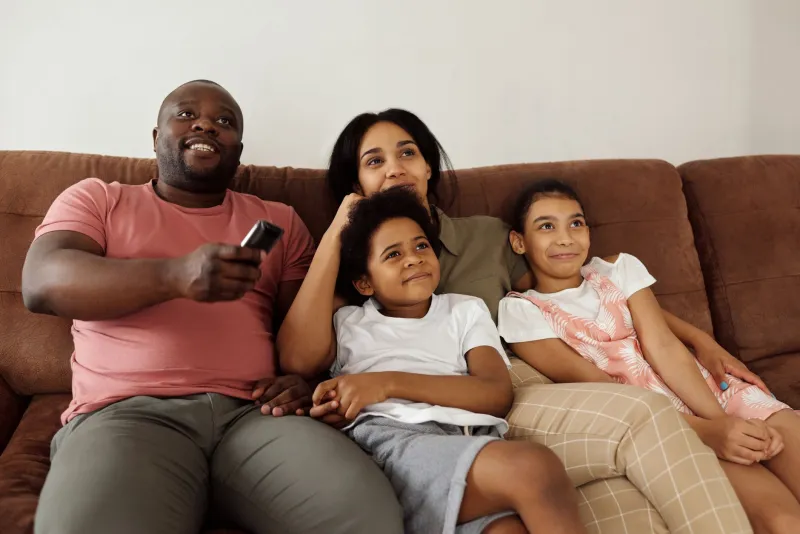
It's a Tuesday night in 1978. Dinner is done. The dishes are drying. Someone in the family mentions — probably with some urgency — that it's almost eight o'clock. The TV gets turned on. The channel gets set. And for the next hour, nobody moves, because whatever is on that screen right now is the only time it will ever be on that screen. Miss it and it's gone. Not gone until it streams somewhere. Gone.
That was the deal American television audiences made for about four decades. The networks set the schedule. You showed up or you didn't.
Three Channels and a Take-It-or-Leave-It Attitude
For most of the postwar television era, American viewers had three choices: ABC, NBC, and CBS. PBS existed on the fringes, and local stations filled odd hours with reruns and local news, but the prime-time landscape was essentially a three-network oligarchy.
Those three networks divided the week into programming blocks, and those blocks were law. Sunday nights had their shows. Thursday had its shows. Friday night was where networks sent series to die — low viewership, young audiences out of the house — which is why so many beloved Friday night shows got cancelled despite passionate fan bases.
If you wanted to watch M*A*S*H, you watched it on Monday at 9 PM Eastern. If you had a conflict — a school event, a late shift, a dinner that ran long — you simply didn't watch M*A*S*H that week. Your neighbor might tell you what happened. You'd piece it together. But you didn't watch it.
The VCR arrived in the late 1970s and started to chip away at this arrangement, but for years it remained a complicated, expensive workaround that a significant portion of the population never fully mastered. The blinking 12:00 on the VCR clock became a cultural shorthand for technological helplessness. Plenty of households owned one and still watched everything live because the alternative was too much hassle.
The Shared Experience Nobody Asked For
Here's where it gets interesting. That rigid, take-it-or-leave-it structure produced something genuinely valuable, even if nobody designed it that way.
Because everyone was watching the same things at the same times, television created a shared cultural fabric in a way that's almost impossible to replicate today. The morning after a major episode — a season finale, a shocking plot twist, a legendary game — the entire country had something to talk about. Not just your corner of Twitter. Everyone. Your coworker, your barber, the cashier at the grocery store, your grandmother.
When the Dallas cliffhanger asked "Who Shot J.R.?" in the spring of 1980, it wasn't a viral moment in the modern sense. It was a genuine national conversation that lasted an entire summer. When the final episode of M*A*S*H aired in February 1983, over 100 million people watched it simultaneously. Water systems in major cities recorded pressure drops during commercial breaks because so many people flushed toilets at the same time. That is a level of shared experience that streaming will never produce.
The Boredom Problem
Of course, the flip side of that shared experience was a certain amount of enforced mediocrity.
If nothing good was on, nothing good was on. You watched anyway, or you turned the set off and found something else to do, or you watched something bad because it was better than silence. Channel surfing — flipping between three options until something passable appeared — was a legitimate leisure activity. People spent real hours of their lives watching shows they didn't particularly like simply because they were there.
Summer was especially grim. Networks aired reruns from May through August, which meant that for roughly a third of every year, American television was essentially a greatest-hits collection of things you'd already seen. Families talked about this openly. "Nothing but reruns" was a common summer complaint, delivered with the resigned tone of someone discussing bad weather.
Kids growing up in this era learned something that feels almost foreign now: sometimes entertainment just isn't available, and that's fine. You go outside. You read. You bother your siblings. The idea that entertainment should be available on demand, in unlimited quantity, at any hour — that wasn't even a concept. It would have sounded like science fiction.
When Scarcity Made Things Matter
The strangest thing about looking back at the network television era is realizing how much the scarcity contributed to the meaning.
Because you couldn't pause, rewind, or rewatch, you paid attention differently. Missing a line of dialogue was a loss you couldn't recover from. Following a complex storyline required genuine investment across weeks and months, without the option to catch up on a recap or re-stream the episode you forgot. Television demanded something from its audience, and audiences gave it.
Special events — the Super Bowl, the Academy Awards, a presidential debate, a moon landing — carried a weight that came partly from the fact that everyone was watching together, right now, with no alternative. The event and the audience existed in the same moment. That's a different relationship with media than anything we have today.
The Infinite Menu and What It Cost
Today's streaming landscape offers something that would have seemed genuinely utopian to a television viewer in 1975: everything, always, on your schedule. You can watch any episode of any show at three in the morning if you feel like it. You can pause, rewind, skip ahead, abandon something halfway through with zero consequence, and find something else in seconds.
It's an extraordinary improvement in pure convenience. And yet.
The shared cultural moment is largely gone. When a prestige series drops its entire season at once, viewers race through it at different paces and quickly diverge in their experience of it. Conversation fragments. Nobody is watching the same thing at the same time anymore.
The stakes are also different. When everything is available forever, nothing feels urgent. You'll get to it eventually. Or maybe you won't. Either way, the show will be there.
That Tuesday night in 1978, when the family gathered because it was almost eight o'clock and the show was starting whether you were ready or not — that wasn't just television. That was a shared appointment with something, a small ritual that organized the evening and connected millions of households doing the exact same thing at the exact same moment.
We traded that for infinite choice, and it was probably the right trade. But it wasn't a free one.