The Envelope on the Counter: When Your Vacation Didn't Exist Until Weeks After You Got Home
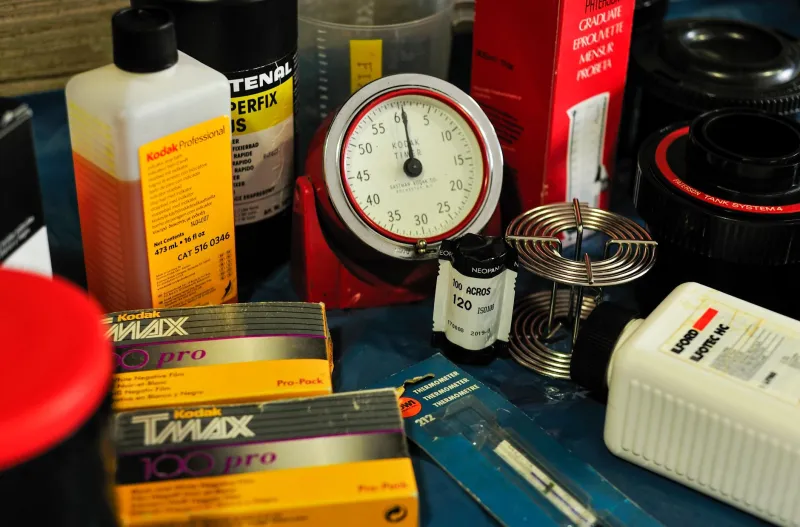
Somewhere in a box in a closet in a house you grew up in, there are probably a stack of those envelopes. The yellow ones, or maybe the green ones with the Kodak logo. The ones that came back from the drugstore or the one-hour photo lab at the mall, stuffed with four-by-six prints and a strip of negatives you were always told to keep but never quite knew why.
If you were born before 1990, you know exactly what it felt like to tear one of those open. And if you weren't, what happened inside that ritual is almost impossible to fully explain.
Twenty-Four Chances to Get It Right
A standard roll of film gave you twenty-four exposures. Some rolls stretched to thirty-six if you were being economical. Either way, that was your budget for an entire trip. Two weeks in Florida, a cross-country drive, a week at a national park — you got twenty-four shots to document all of it.
That number shaped behavior in ways that are almost alien now. You didn't photograph your breakfast. You didn't take six nearly identical pictures of the same sunset to pick the best one later. You composed your shot, made a judgment call, pressed the button, and moved on — hoping for the best but knowing you wouldn't find out for a while.
Kids at Disney World didn't get a photo in front of every ride. You picked your moments. The castle at the right time of day. The whole family in one frame. Maybe the kids with Mickey if the line wasn't too long. Twenty-four frames felt like a lot until you were on day three of a two-week trip and had already used half of them.
The Lab Was a Mystery Box
Once the roll was finished, you rewound it, popped it out, and eventually dropped it off somewhere — a drugstore, a dedicated photo lab, sometimes a kiosk in a mall parking lot. Then you waited. Standard processing took a week or two. If you paid extra for rush service, maybe a few days. Either way, you left on vacation, came home, unpacked, went back to work, and then found out if your pictures turned out.
This is the part that's genuinely hard to communicate to anyone who's only ever used a smartphone. You had no idea what you had. The photo you were most confident about might come back blurry, badly exposed, or cut off at the edge because you misjudged the frame. The shot you took as an afterthought — the one you almost didn't bother with — might be the best photo you'd ever taken in your life.
You simply didn't know. And that uncertainty changed the entire relationship between the trip and the memory.
Vacation Existed in Two Separate Chapters
There was the trip itself — the sunburn, the bad motel coffee, the argument about directions, the moment at the rim of the Grand Canyon that left everyone quiet. That was chapter one.
Chapter two happened weeks later, at the kitchen table, when the envelope finally arrived. You went through the prints one by one, rediscovering things you'd half-forgotten, laughing at the ones that didn't turn out, and occasionally finding a photograph that captured something better than your memory had. The blurry one of your kid mid-laugh on a roller coaster. Your parents holding hands in front of something forgettable. The accidental shot of your own feet that somehow felt like a document of the whole trip.
That second chapter was its own experience. The trip got relived, reordered, and solidified into a shared story. The photos that survived became the official record. Everything else — the moments nobody photographed — gradually faded into the softer stuff of family lore.
What Instant Gratification Actually Cost Us
Digital photography, and then smartphones, collapsed those two chapters into one. Now you see the photo the second you take it. You retake it if it's not right. You share it before you've even left the location. By the time you get home, the trip has already been documented, curated, and partially distributed across social media.
In one sense, this is a straight-up improvement. You get better photos. You don't waste money on rolls that don't turn out. You can capture far more moments without any of the anxiety about running out of film.
But something subtle got lost. The delay between experience and documentation used to create a kind of breathing room. The trip was allowed to just be the trip, unmediated and unfiltered, while it was happening. Memory did its first pass before the photos arrived to overwrite it. You remembered how something felt before you saw how it looked.
Now the camera is always between the moment and the person living it. We document in real time, which means we're always at least partially performing the experience rather than just having it.
The Envelope Was the Proof
There's something worth sitting with here. For most of American history, a vacation was essentially a story you told with your own words until the photos arrived to confirm it. Your memory was the primary document. The photographs were the supplement.
Now it's the other way around. The photos are the primary document. The memory is optional.
Neither version is wrong. But they produce very different relationships with the places you've been and the moments you've lived through. The envelope on the counter, the anticipation of tearing it open, the surprise of seeing your own past returned to you in a stack of four-by-sixes — that was a different kind of travel souvenir. One that took time to arrive and meant something because of it.