The Check That Arrived Every Month: How America Stopped Guaranteeing Retirement
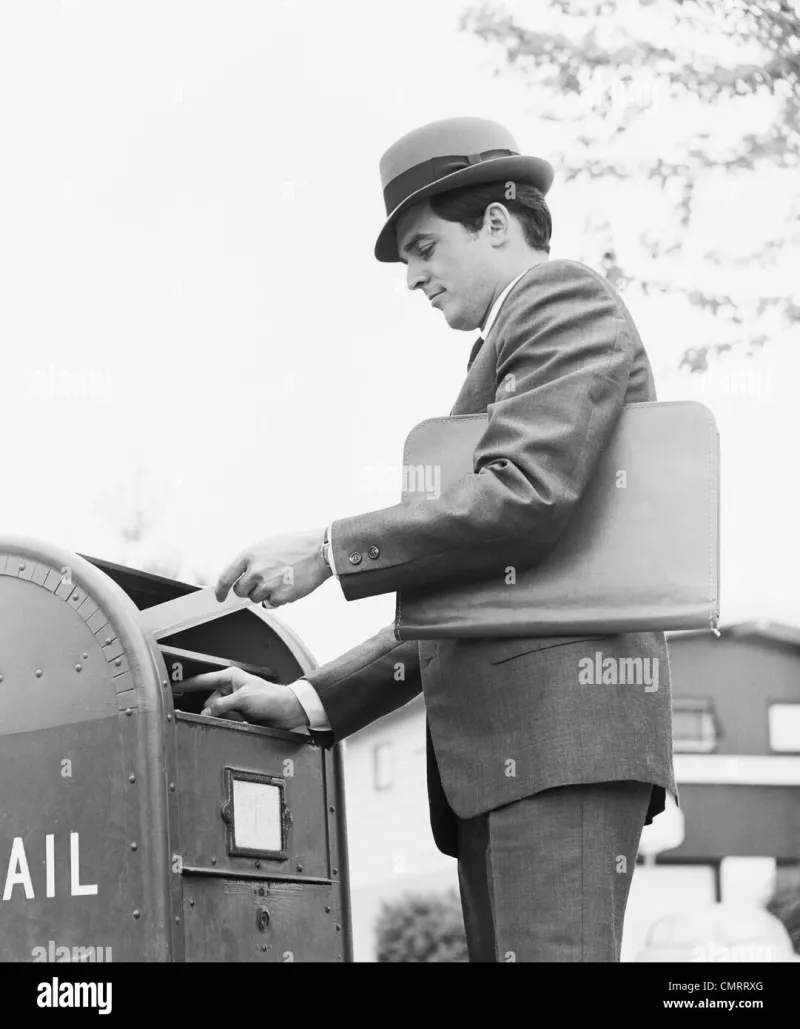
Photo: retirement check pension mailbox 1970s American worker, via c8.alamy.com
Picture a man retiring from a manufacturing company in Ohio in 1974. He's worked there for thirty-one years. He knows the floor supervisors by name, has eaten lunch in the same break room for three decades, and has watched the company grow from a regional operation into something considerably larger. On his last day, there's a small party. Someone gives a speech. He receives a watch engraved with his name and his years of service.
And then, for the rest of his life, a check arrives in the mail every month. Not a large check, but a predictable one. Enough to cover the mortgage, the groceries, and a modest vacation every other year. He never has to think about it. It simply comes.
That world is largely gone. And most Americans under fifty have never lived in it.
What a Pension Actually Was
The defined-benefit pension was, at its core, a promise. An employer promised that if you stayed long enough and worked hard enough, they would provide you with a fixed monthly income from the day you retired until the day you died. The formula varied by company and industry, but the basic structure was consistent: your benefit was calculated based on your years of service and your final salary, and it was guaranteed regardless of what the stock market did, what interest rates looked like, or how long you happened to live.
From the worker's perspective, the beauty of the system was its simplicity. You didn't need to understand asset allocation or expense ratios or the difference between a Roth and a traditional account. You didn't need to decide how aggressively to invest or whether to rebalance your portfolio. You showed up. You stayed. You retired. The check came.
Pensions peaked in American corporate life during the postwar decades — the 1950s, 1960s, and into the 1970s. At their height, roughly half of private-sector workers in the United States were covered by a defined-benefit plan. For public-sector employees — teachers, firefighters, police officers, government workers — the coverage rates were even higher. Retirement security was, for a significant portion of the American workforce, a genuine expectation rather than an aspiration.
The Quiet Pivot of 1978
The mechanism that unraveled the pension era was almost comically understated in its origins. In 1978, Congress passed the Revenue Act, which included a small provision — Section 401(k) — that allowed employees to defer a portion of their salary into a tax-advantaged account. The intention was modest: a supplementary savings vehicle, not a replacement for anything.
But corporate America saw something else. The defined-benefit pension was expensive. It required employers to fund a liability that could stretch decades into the future, managed by professional investment teams, and guaranteed regardless of market performance. The 401(k), by contrast, shifted the cost — and the risk — entirely onto the employee. Companies contributed matching funds if they chose to, but the obligation ended there. If the market crashed in the year before an employee's retirement, that was the employee's problem.
Throughout the 1980s and 1990s, companies began freezing and terminating their pension plans in favor of 401(k) offerings. The transition was framed, often genuinely, as giving workers more flexibility and control over their own futures. And for financially sophisticated employees who invested wisely over long careers in strong markets, it sometimes worked out that way.
For everyone else, it was a transfer of risk they hadn't asked for and weren't equipped to manage.
The Skills Nobody Taught Anyone
Here is the fundamental problem with replacing a guaranteed pension with a self-directed investment account: it assumes the person holding the account knows what they're doing. And for most of the twentieth century, most American workers had no particular reason to develop that knowledge. Financial literacy — understanding compound interest, market cycles, diversification, fee structures — was not a standard part of American education. It still isn't, in most states.
So a generation of workers who had grown up expecting a pension were suddenly handed 401(k) plan documents and asked to make decisions that professional fund managers spend careers learning to navigate. Many made predictable mistakes. They invested too conservatively and watched inflation erode their savings. They invested too aggressively and took catastrophic losses in market downturns — 2001, 2008 — at precisely the wrong moments in their careers. Some simply didn't contribute enough, especially in their younger years when the behavioral math of retirement felt too abstract and too distant.
The 2008 financial crisis was a particularly brutal demonstration of the system's fragility. Workers who were five or ten years from retirement watched their account balances drop by thirty or forty percent in a matter of months. Under the old pension model, that market collapse would have been largely irrelevant to their retirement income. Under the 401(k) model, it was potentially devastating.
Where Things Stand Now
Today, defined-benefit pensions in the private sector are functionally extinct outside of a handful of unionized industries. Public-sector pensions survive but face chronic underfunding pressures in many states, and their long-term viability is a persistent political flashpoint. The 401(k) — supplemented by an IRA for those who use one — is now the primary retirement savings vehicle for the vast majority of American workers.
The results are mixed, to put it charitably. Federal Reserve data consistently shows that a significant portion of Americans approaching retirement age have saved far less than they'll need. The median retirement account balance for workers in their late fifties is a fraction of what financial planners recommend. Social Security, which was designed as a supplement to pension income rather than a primary source, has become the closest thing to a guaranteed monthly check that most retirees can count on.
Meanwhile, the people who benefited most from the 401(k) era tend to be those who were already financially advantaged — higher earners who could afford to contribute the maximum, who had the knowledge or resources to invest wisely, and whose careers were long and stable enough to ride out market downturns. The system rewards financial sophistication and penalizes its absence.
The Contract That Was Quietly Rewritten
The shift from pension to 401(k) wasn't announced as a fundamental restructuring of the social contract between employers and workers. It happened incrementally, plan by plan, company by company, over the course of two decades. By the time most people noticed how completely the landscape had changed, the old world was already gone.
The man with the engraved watch and the monthly check represents something that felt, for a generation, like the natural reward for a working life. Today, that reward requires decades of self-directed financial management, a tolerance for market volatility, and a fair amount of luck with timing. Whether that trade was a net improvement for American workers is a question the data has largely answered — and not in the way the architects of the 401(k) era promised it would.