The Phrasebook in Your Pocket and the Meal You'll Never Forget: Traveling Abroad Before the Smartphone
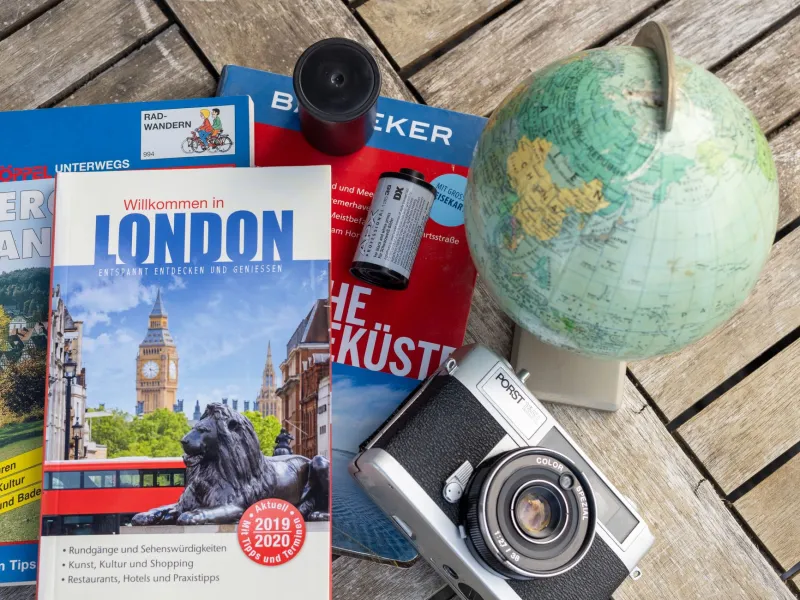
Somewhere in a box in a closet, there is probably a worn paperback with a cracked spine that belongs to someone in your family. It's small enough to fit in a jacket pocket. The cover says something like French for Travelers or Essential Italian Phrases and the pages are dog-eared at the sections on restaurants and emergencies. If you look closely, a few phrases are underlined in pen.
That little book was once the difference between eating dinner and going hungry in a foreign city. Between finding your hotel and sleeping on a bench. Between understanding what you'd accidentally agreed to and having absolutely no idea until it was too late.
You Prepared, and Then You Improvised
Before smartphones changed international travel completely, the preparation process for a trip abroad had a particular texture to it. You bought a guidebook — Fodor's, Frommer's, Lonely Planet if you were the adventurous type — and you actually read it. Not skimmed it. Read it, took notes, folded pages. You wrote down addresses in a small notebook because there was no map application to rescue you if you forgot.
The phrasebook was its own ritual. Travelers would spend evenings before departure memorizing key phrases, practicing pronunciation out loud, rehearsing imaginary conversations with shopkeepers and taxi drivers. Où est la gare? Where is the train station? Quanto costa? How much does it cost? Parlez-vous anglais? Do you speak English — the phrase that, when answered with a confident "oui" or "sì," produced a wave of relief that's hard to describe unless you've felt it.
And then you landed, and reality immediately departed from the rehearsal.
The Beautiful Chaos of Not Understanding
Here's what the phrasebook didn't prepare you for: speed.
Native speakers don't speak the way phrasebooks are written. They speak fast, they use slang, they drop syllables, and they respond to your carefully rehearsed question with a rapid-fire answer that contains none of the words you studied. You'd successfully ask where the train station was and then stand there nodding as the answer — delivered in a cheerful blur — washed over you completely.
The solution was gesture, expression, and a kind of improvisational pantomime that broke down language barriers through sheer physical commitment. Americans abroad in the pre-smartphone era became surprisingly good at communicating through pointing, drawing, and facial expressions that conveyed urgency, gratitude, or confusion. Locals, for their part, were often remarkably patient with the spectacle.
Meals were a particular adventure. Menus in foreign restaurants frequently offered no translation, and even if they did, the translation was sometimes more confusing than the original. Ordering became an act of faith. You pointed at something that looked good on another table, or you picked a word that sounded vaguely familiar, or you simply said il menu fisso — the set menu — and accepted whatever arrived with the cheerful resignation of someone who had stopped trying to control outcomes.
What arrived was sometimes strange. Occasionally it was something you'd never encountered before and couldn't identify. But it was almost always memorable, and it was always a story.
Getting Lost Was Part of the Trip
Navigation without GPS produced a different kind of travel experience — one that modern tourists, phone in hand, rarely encounter.
You got lost. Genuinely, sometimes significantly lost. You took a wrong turn out of a train station and ended up in a neighborhood that wasn't in your guidebook. You misread a hand-drawn map given to you by the hotel concierge and spent forty minutes walking in the wrong direction. You discovered, sometimes by accident and sometimes by necessity, places that weren't on any itinerary.
This is where something interesting happened. When you're lost in a foreign city without a device to immediately correct your course, you actually look at where you are. You notice the street you're on, the people around you, the smell of whatever is cooking in the café you just passed. You stop and ask someone for help, which requires interaction — real, human, fumbling interaction — that produces its own unexpected rewards.
Americans traveling abroad in the 1980s and early 1990s came home with stories that all had a similar shape: something went wrong, they didn't know what to do, they stumbled into a solution, and the stumble became the best part of the trip. The afternoon they got completely turned around in a Moroccan medina and ended up having tea with a carpet merchant who spoke three words of English. The train they accidentally boarded to the wrong city and the conversation that resulted. The restaurant they found because they were too exhausted to keep searching and it turned out to be extraordinary.
Those stories exist because the traveler had no safety net. The phone in your pocket is a safety net, and safety nets, by design, prevent the fall — including the falls that turn into adventures.
What the Friction Was Actually Doing
There's a concept in travel writing about the value of friction — the idea that difficulty, inconvenience, and uncertainty are not obstacles to meaningful travel but actually ingredients in it. The harder you have to work to communicate, navigate, and understand a place, the more of your attention that place demands. And attention is how places become real to you.
When you spend twenty minutes trying to explain to a pharmacist in rural Portugal that you need something for a headache, using mime and a pocket dictionary and eventually drawing a picture of a head with lightning bolts coming out of it, you are not having a smooth experience. But you are completely, utterly present. You are paying attention to every detail of that interaction in a way that no frictionless app-assisted transaction will ever require.
Modern travel technology is genuinely remarkable. The ability to translate a menu in real time, navigate an unfamiliar city on foot with turn-by-turn directions, and communicate basic needs in any language instantly — these tools have made international travel accessible to people who would have found it genuinely daunting before. That's worth a lot.
But something shifted when the friction disappeared. The stories got shorter. The misadventures got rarer. The afternoons that went sideways and became the whole point of the trip — those happen less often when there's always a correct answer available in your pocket.
The Phrasebook Didn't Know Everything, and That Was the Point
The dog-eared phrasebook in that box in that closet couldn't tell you what to do when the train was cancelled, the hotel had lost your reservation, or the dish you ordered turned out to be something you'd never heard of. It gave you a framework and then left you on your own.
That gap — between what you'd prepared for and what actually happened — was where the real travel took place.
The world before smartphones didn't offer better travel. It offered different travel: slower, less certain, more dependent on human connection and improvised problem-solving. The traveler who came home from two weeks in Europe in 1989 had genuinely navigated something. They had been confused and lost and occasionally embarrassed, and they had figured it out anyway.
That's a different souvenir than anything you can buy in an airport gift shop. And it fits in your memory a lot better than a phrasebook fits in your pocket.