The Arrival of the Wish Book
Every September, like clockwork, the thick catalogs would start arriving. First came Sears with its famous "Wish Book," weighing nearly three pounds and containing over 1,400 pages of everything from refrigerators to children's toys. Then Montgomery Ward's catalog, followed by J.C. Penney's, each one landing on doorsteps across America with the weight and promise of possibility.
Families would gather around the kitchen table with these catalogs spread open like maps to distant treasure islands. Children would flip immediately to the toy sections, while parents studied appliances, clothing, and household goods with the intensity of scholars examining ancient texts. The catalog wasn't just a shopping tool—it was entertainment, aspiration, and often the closest thing to a department store that rural Americans would see all year.
"The Sears catalog was our mall," remembers Linda Thompson, who grew up on a farm in Nebraska during the 1960s. "We'd spend hours looking at everything, dreaming about what we might order, planning our Christmas lists. It was like having a window into a world of possibilities that we could actually afford."
The Art of the Circle and the Dream
Shopping by catalog required a specific set of skills that today's consumers have never developed. First, you had to master the art of circling items with a pen—not too lightly that you'd forget what caught your eye, but not so enthusiastically that you'd commit to purchases you couldn't afford. Families developed their own systems: circles for "maybe," stars for "definitely," and question marks for "if we have money left over."
The catalogs became collaborative documents, passed between family members who would add their own circles and notes in the margins. Children would lobby for toys by repeatedly circling the same items and leaving the catalog open to strategic pages. Parents would compare prices across different catalogs, calculating shipping costs and delivery times like military strategists planning a campaign.
"I remember spending entire Sunday afternoons with the Montgomery Ward catalog," recalls James Mitchell, whose mother ordered most of their family's clothing through mail-order. "She'd measure us kids, check the sizing charts, and calculate exactly what we needed for school. Every decision had to be perfect because returning things was such a hassle."
The Great Order Form Challenge
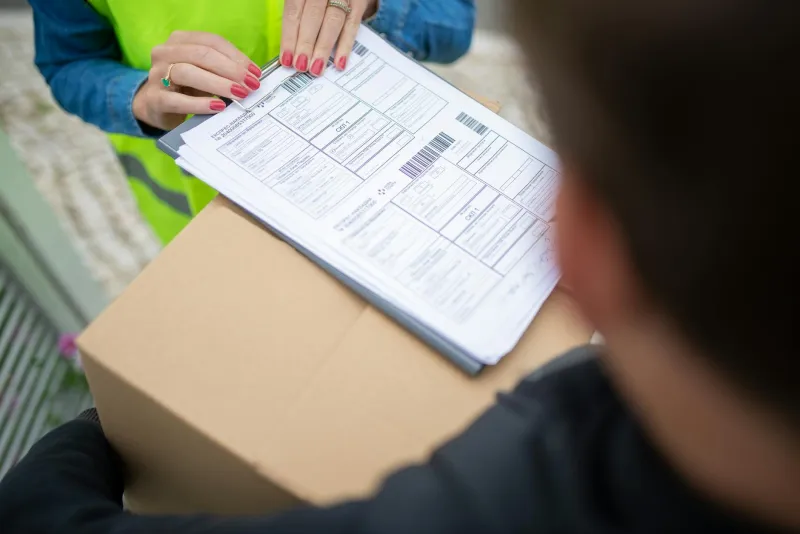
Once you'd made your selections, the real work began: filling out the order form. These multi-part carbon forms required precision that would challenge today's online shoppers. You had to write clearly in small boxes, calculate shipping costs using complex charts, add tax where applicable, and double-check every item number against the catalog descriptions.
One mistake—a transposed digit in an item number, an error in size or color selection, or a miscalculation of the total—could result in receiving the wrong items or having your entire order rejected. There was no "edit cart" button, no auto-calculated shipping, no saved payment information. Every order was a fresh exercise in careful handwriting and basic mathematics.
The forms themselves were works of bureaucratic art, designed to capture every possible variable: item number, page number, description, size, color, quantity, unit price, and total price. At the bottom, you'd add shipping costs, calculate tax, and arrive at a grand total that often seemed surprisingly large compared to your initial expectations.
The Envelope, the Check, and the Leap of Faith
Paying for catalog orders required a level of trust that modern consumers would find terrifying. You'd write a check for the full amount, tear off the appropriate number of order forms, stuff everything into an envelope, and mail it off to a warehouse in Chicago or Baltimore or Kansas City. Then you'd wait, having sent real money into the void with nothing but faith that the right items would eventually arrive.
Credit cards existed but weren't widely accepted for mail orders until the late 1970s. Most families paid by check or money order, which meant the money was gone the moment the envelope left their mailbox. If something went wrong—if items were out of stock, damaged in shipping, or simply the wrong size—resolving the problem required letters, phone calls, and weeks of back-and-forth communication.
"You had to really want something to order it by mail," explains Patricia Davis, whose family relied heavily on catalog shopping in rural Montana. "It wasn't impulse buying—it was a commitment. You were sending away real money and hoping for the best."
The Waiting Game
Modern consumers expect tracking numbers, delivery estimates, and real-time updates about their orders. Catalog shoppers lived with uncertainty that would drive today's shoppers to distraction. The standard promise was "allow 4-6 weeks for delivery," but that was more hope than guarantee. Orders placed in November might arrive in January, if they arrived at all.
Families would mark calendar dates when they expected orders to arrive, then adjust their expectations as weeks stretched into months. The mail carrier became a figure of intense interest, especially during the Christmas season when catalog orders represented the bulk of holiday gifts.
"We'd start watching for packages in early December," remembers Michael Rodriguez, whose family ordered Christmas gifts exclusively through catalogs. "Every day that the mailman came empty-handed was another day of wondering if our gifts would make it in time. Sometimes they didn't."
When Wrong Was Really Wrong
Receiving the wrong item from a catalog order was a disaster that could take months to resolve. Unlike today's easy returns and instant replacements, catalog mistakes required letter-writing campaigns, return shipping at your own expense, and long waits for refunds or exchanges.
The most common problems were sizing issues—clothing that didn't fit despite careful measurements, shoes that were too narrow or too wide, or appliances that were larger or smaller than expected. Without the ability to see and touch items before purchase, catalog shoppers developed elaborate strategies for estimating size, quality, and color based on small black-and-white photographs and brief descriptions.
"I once ordered a 'forest green' sweater that arrived in what I can only describe as electric lime," recalls Susan Chen, who did most of her shopping through catalogs in the 1970s. "The return process took three months and cost me almost as much in shipping as the sweater itself. After that, I stuck to basic colors."
The Magic of Anticipation
Despite all the frustrations and uncertainties, catalog shopping created a sense of anticipation that modern instant gratification cannot replicate. The weeks between ordering and receiving created a sustained excitement that made the eventual arrival feel like Christmas morning, regardless of the season.
Children who had circled toys in September would spend October and November imagining the moment when those packages would finally arrive. The delay between desire and fulfillment created a space for dreams to grow, for excitement to build, and for the actual receipt of goods to feel genuinely special.
"There was something magical about waiting for a catalog order," reflects Thompson. "You'd almost forget what you'd ordered by the time it arrived, so opening the package was like getting a surprise gift from your past self. Today's instant delivery doesn't have that same emotional impact."
The End of an Era
The rise of suburban shopping malls in the 1970s and 1980s began the decline of catalog culture, offering immediate gratification and the ability to see and touch merchandise before purchase. The internet and online shopping completed the transformation, making the careful ritual of catalog ordering seem as antiquated as writing letters by candlelight.
Today's consumers can order items while standing in line at coffee shops, track packages in real-time, and return purchases with a few clicks. The friction that once made catalog shopping an exercise in patience and planning has been eliminated, replaced by algorithms that predict what we want before we know we want it.
What We Gained and Lost
The efficiency gains are undeniable—modern e-commerce is faster, more accurate, and more convenient than catalog shopping ever was. But something intangible disappeared when we eliminated the waiting, the uncertainty, and the ritual of careful selection that defined the catalog era.
We lost the shared family experience of gathering around catalogs, the anticipation that made receiving packages feel special, and the deliberate decision-making that prevented impulse purchases. Most importantly, we lost the understanding that getting what you want should require effort, patience, and a little bit of faith in the unknown.
The thick catalogs that once arrived each fall represented more than shopping opportunities—they were invitations to dream, plan, and participate in a ritual that connected families across the country in a shared experience of hope and anticipation. That's something no algorithm can deliver, no matter how fast the shipping.