The $100 Shopping Cart: How a Half-Century Transformed What Americans Eat, Buy, and Can Afford
The $100 Shopping Cart: How a Half-Century Transformed What Americans Eat, Buy, and Can Afford
Let's start with a number: $100. In 1975, that was a meaningful sum — roughly equivalent to about $570 in today's money, once you adjust for inflation. Take that amount to a grocery store in suburban America fifty years ago, and you'd come home with a cart stacked high enough to feed a family of four for a week and a half, maybe two weeks if you were careful about it.
Take $100 to that same grocery store today — or rather, its modern equivalent — and the picture looks considerably different. You'll still eat. But the cart will be lighter, the choices will be overwhelming, and the experience of spending that money will tell a story about American life that goes well beyond simple price tags.
What $100 Bought in 1975
To understand the 1975 grocery run, you have to understand the store itself. The average American supermarket in the mid-1970s stocked roughly 8,000 to 9,000 distinct products. There was one kind of soy sauce. Maybe two or three varieties of salad dressing. Yogurt existed, but it occupied a small corner of the dairy case rather than an entire aisle. Organic produce wasn't a category — it was just produce. The concept of "gluten-free" as a consumer choice was decades away.
A realistic $100 cart in 1975 might have looked something like this: a whole chicken and a few pounds of ground beef, a dozen eggs, a gallon of whole milk, a large block of Velveeta (enormously popular at the time), white sandwich bread, a bag of potatoes, canned vegetables — green beans, corn, peas — a box of Jell-O, some Wonder Bread, a can of Maxwell House coffee, a box of Kellogg's Corn Flakes, and a few other pantry staples. Maybe a couple of pork chops if there was a sale.
This was not gourmet eating. But it was substantial. It was caloric. It covered the bases of what most American families considered a normal week of meals.
In 1975, the average American family spent about 13 to 14 percent of their household income on food. That number has since dropped to roughly 11 percent — which sounds like good news, until you start pulling at the threads.
What $100 Buys in 2025
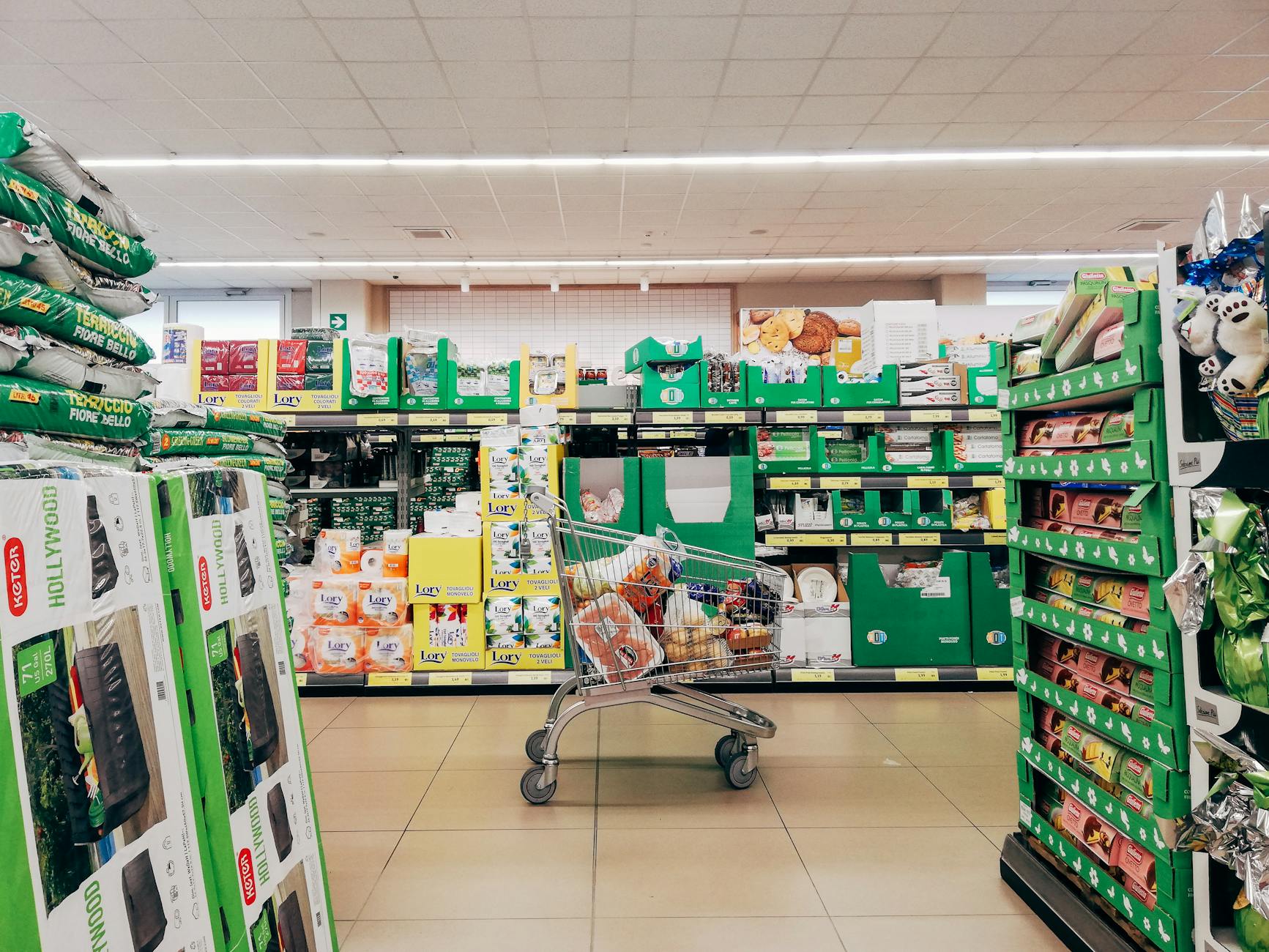
The modern grocery store is a fundamentally different environment. Today's average supermarket carries somewhere between 30,000 and 50,000 SKUs — that's individual product variations, not just product categories. There are 47 varieties of pasta sauce where there used to be two. Greek yogurt alone has its own substantial real estate. The produce section stocks fruits and vegetables from around the world that simply weren't available in American stores in 1975: mangoes, bok choy, dragon fruit, pre-washed baby arugula in a plastic clamshell.
But here's the catch: $100 in 2025 is worth considerably less than $100 in 1975, even accounting for wage growth. If you take that $100 into a modern store, you might get: a rotisserie chicken (faster than cooking a whole bird and often cheaper, which is its own economic marvel), a dozen eggs, a gallon of milk, a loaf of bread, one pound of ground beef, a bag of salad mix, a couple of cans of beans, a box of pasta, a jar of sauce, some apples, and a box of cereal. You'd probably have a few dollars left over, but not many.
The actual purchasing power for a basic food basket has eroded meaningfully — particularly in the past four years, when grocery inflation ran at rates not seen since the 1970s themselves. Eggs, which became a flashpoint in early 2025, hit prices that seemed almost satirically high compared to living memory. A carton that cost 61 cents in 1975 (around $3.50 adjusted for inflation) was selling for $5, $6, or more in many markets.
What Got Cheaper, What Didn't
The inflation story is real, but it's not uniform — and that's where things get genuinely interesting.
Some things have gotten dramatically cheaper in real terms. Chicken, for instance, is significantly more affordable per pound today than it was in 1975, largely due to industrialized poultry farming that has made production faster and cheaper at scale. Bananas cost almost the same in nominal dollars as they did decades ago. Canned goods, dried pasta, and shelf-stable staples have held up reasonably well against inflation.
Other things have become quietly out of reach for many households. Fresh fish. Olive oil. Organic produce. Specialty items that have moved from the margins to the mainstream — things like almond milk, artisan cheese, or pre-made meal kits — carry price tags that reflect both their ingredients and the convenience premium built in.
And then there's the category that doesn't fit neatly into either column: highly processed food. A box of name-brand crackers, a bag of chips, a frozen dinner — these items are cheap in absolute terms, and they're engineered to be satisfying. But they represent a category that barely existed in 1975 and now accounts for roughly 60 percent of the average American's caloric intake. The proliferation of ultra-processed food is arguably the single biggest shift in what Americans actually eat compared to fifty years ago.
Are We Eating Better?
This is the question the $100 cart ultimately raises, and it doesn't have a clean answer.
In some measurable ways, yes. Americans today have access to a far more diverse range of foods than their 1975 counterparts. Nutritional science has advanced. Food safety standards are stronger. The availability of fresh produce year-round — something that was genuinely limited in many parts of the country half a century ago — is taken entirely for granted now.
But the obesity rate in 1975 was around 15 percent. Today it's over 40 percent. Diet-related chronic disease is at historic highs. The explosion of choice in the modern grocery store coexists with a national diet that, in many measurable ways, is less healthy than it was when there were only two kinds of salad dressing.
The $100 cart doesn't just reveal inflation. It reveals a country that produces more food than ever, wastes more food than ever, and is still, somehow, struggling to feed itself well. That's a gap worth sitting with — the distance between abundance and nourishment, measured one shopping trip at a time.